Today
Air today
Quality-checked atmospheric context for a saved home, with freshness shown when available.

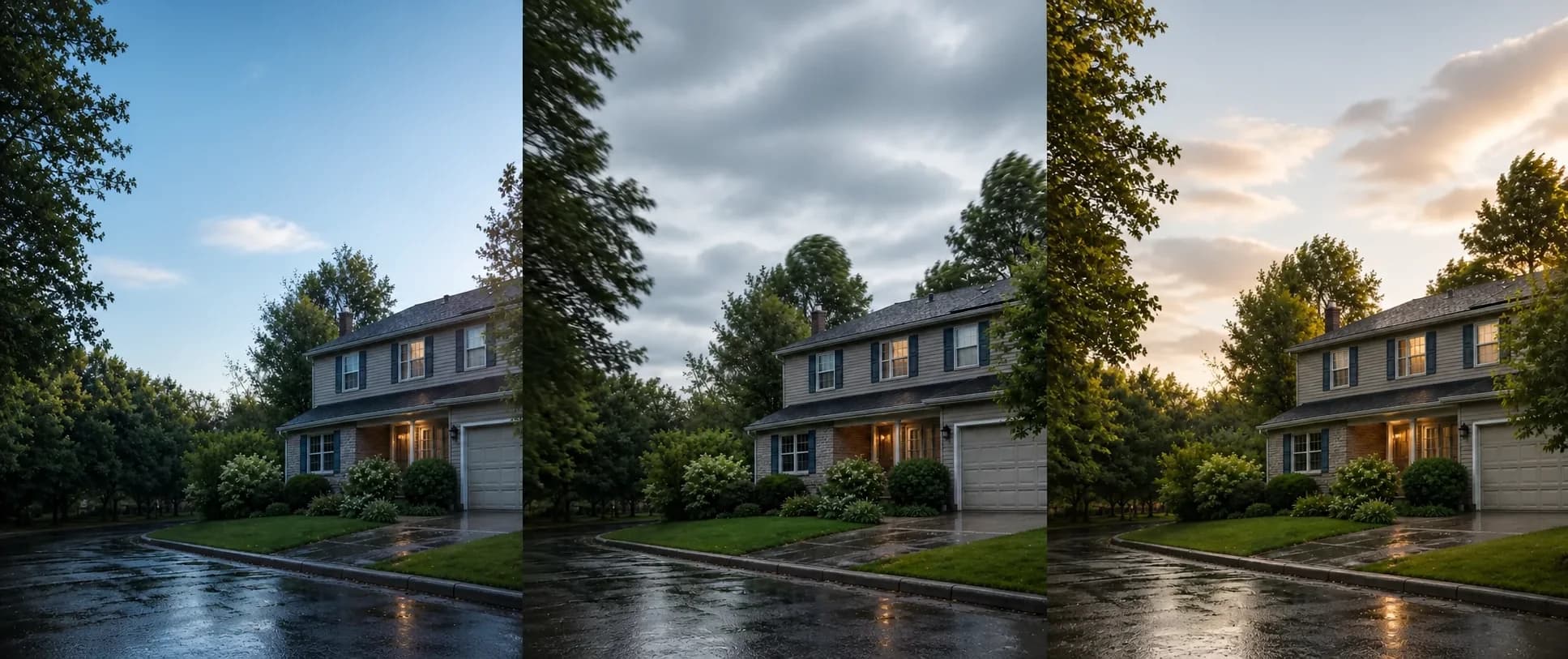
One home, moving through time
Read air today, seven-day guidance, and long-range conditions toward 2050 in one calm report.
Time changes what the evidence can say, so each outlook keeps its own name and limits.
Air today
Next 7 days
Home Outlook
Focused product views keep each time horizon readable and make index direction explicit.
Near-term Concern Index
Illustrative result
Higher means more attention.
Leading concern: combined near-term conditions
Review exposed outdoor items and local guidance for the relevant timeframe.
A 1-100 attention index from independent near-term signals kept separate from long-range planning. The live report names the leading theme and relevant timeframe.
Higher means more attention.
It is not a probability, official warning, or observation at the property.
Home Concern Index
Illustrative result
Higher means more attention.
Leading concern: future heat
Review shade and cooling before the next major home upgrade.
A 1-100 long-range attention index from normalized independent signals and relevant home context.
Higher means more attention.
It is a planning screen, not a damage, loss, inspection, or insurance score.
Home Concern Index
Illustrative result
Higher means more attention.
Future heat needs a practical planning step.
Plan exterior shade, ventilation, and cooling readiness.
Actions appear only when the evidence state supports them. Low concern and missing evidence do not manufacture advice.
Guidance stays tied to the signal that supports it. Planning guidance, not inspection advice.
The property stays central while evidence moves from source to outlook to action.
Keep your address and saved report inside the secure Vault.
Review the location and available building details.
See current, forecast, and projected evidence separately.
Use sourced guidance alongside qualified local advice.
Confidence and coverage stay beside the result. Missing information remains missing instead of becoming a reassuring number.
Honest gaps
Available
Usable information supports the result shown.
Limited coverage
Useful available measurements or context may remain visible with a limitation, but an unsupported index is withheld.
No coverage
The result is withheld for this location or request.
Temporarily unavailable
A current usable result cannot be shown yet.
Coverage
Is there enough usable information for this location?
Freshness
Is the result current enough for its intended horizon?
Consistency
Do the signals agree well enough to support a stable result?
Confidence
How strongly can the available information support this reading?
Manage more than one property?
Rank priorities, compare groups, filter hundreds of locations, and move from a portfolio index to the properties behind it.
Talk to usThree example locations on one fixed 1-100 attention axis.
Higher needs attention
Urgent attention
North distribution hub
High attention
Riverside rental
Watch
Cedar Street home
Want the decision framework? Review Methodology.
Yes. Create a free account to calculate an address, save a property, and open its live report. The public sample is fictional and illustrative; it is not an unauthenticated address calculation.
A 1-100 long-range attention index from normalized independent signals and relevant home context. Higher means more attention. Modeled energy, Air today, and the Near-term hazard outlook remain separate services.
No. TerraCube is a screening tool, not a property inspection, utility measurement, certified efficiency rating, actuarial assessment, or insurance assessment. Climate projections describe plausible conditions at an address; they do not predict damage, loss, health outcomes, or a particular event.
Treat it as an experimental heating-and-cooling demand estimate based on saved home size and modeled climate conditions. It is not measured utility use. Version 1 has no energy-price or bill interface. Stored fuel mix, utility history, and an all-electric bill view are possible follow-up work, not current features.
TerraCube reports limited data, no coverage, or temporarily unavailable instead of inventing a value. Coverage controls block unsupported conclusions, while malformed evidence returns an error rather than a successful assessment.
Yes. TerraCube supports a curated range of established climate pathways so you can compare a lower-change future with more intensive warming conditions. Each pathway is processed independently and keeps its own coverage state.
Home Outlook focuses on a mid-century planning horizon toward 2050. This keeps the result relevant to long-lived home decisions without presenting distant projections as near-term certainty.
TerraCube evaluates independent signals in the context of a saved home, keeps time horizons separate, and checks coverage, freshness, consistency, and confidence before showing a supported result. Public explanations stay high level, and missing information remains missing.
Create a free account to review each horizon, its evidence, and the next practical step.